
Param College
Your Path to Job Oriented Courses
Approved by NCVT, MSME, UGC, QCI, MHRD | ISO 9001:2015 & 14001:2015 Certified College
Your Path to Job Oriented Courses
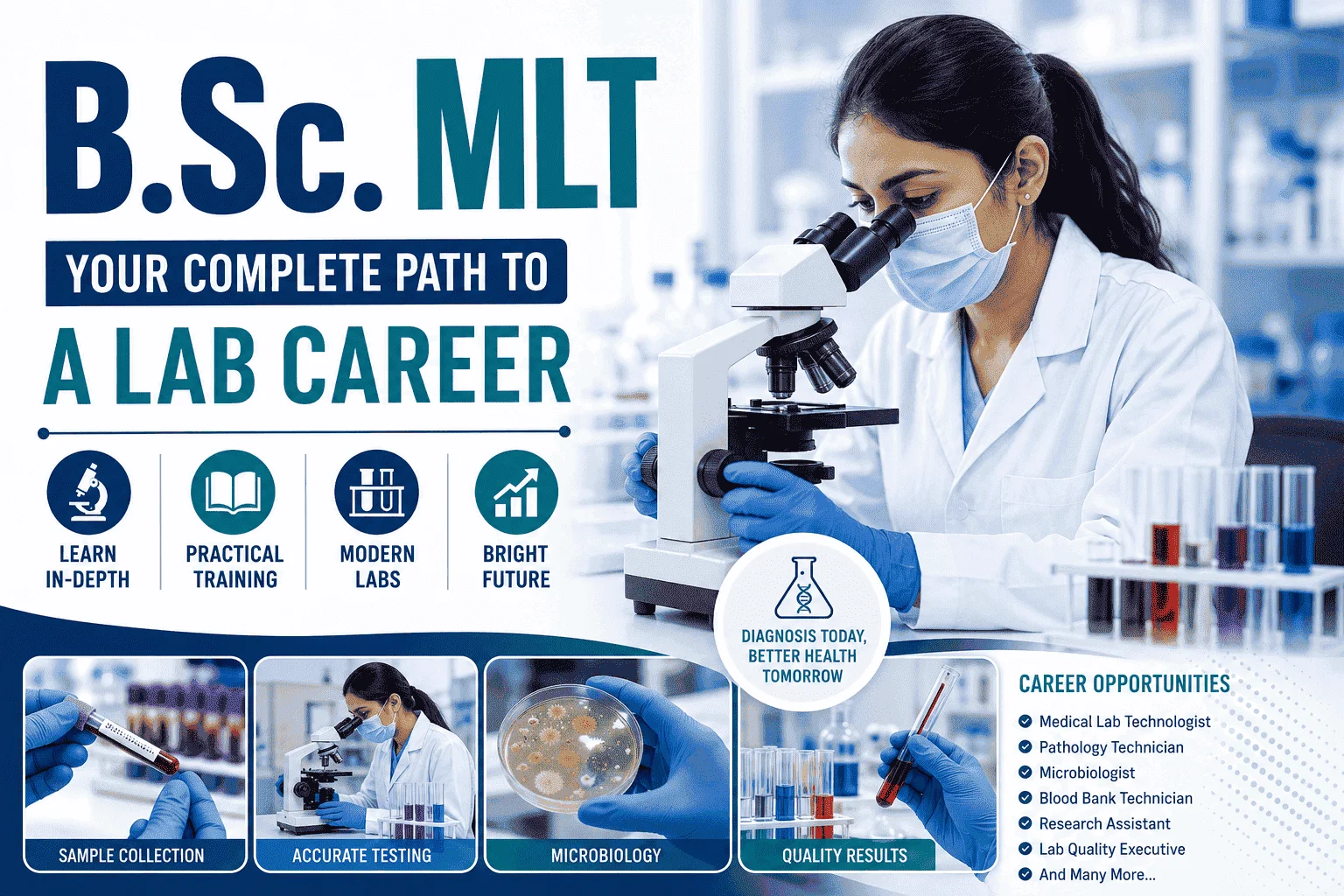
A B.Sc. MLT (Bachelor of Science in Medical Laboratory Technology) is a career-focused undergraduate course for students who want to build a career in medical laboratories, diagnostics, healthcare, and clinical research. Medical laboratory professionals play an important role in detecting diseases, analyzing samples, and supporting doctors in making accurate treatment decisions.
If you are interested in biology, laboratory work, medical testing, and healthcare technology, B.Sc. MLT can be a practical choice for starting a rewarding healthcare career.
B.Sc. MLT is generally a three- to four-year undergraduate degree, depending on the university and course structure. The program combines theoretical knowledge with practical laboratory training.
Students learn how to collect and examine clinical samples such as blood, urine, tissues, and other specimens. The course also introduces students to modern diagnostic techniques, laboratory equipment, microbiology, pathology, biochemistry, and hematology.
The goal is to prepare students to perform laboratory tests accurately while following proper safety and quality-control procedures.
Eligibility requirements can vary between universities. Generally, students who have completed Class 12 with Science subjects, particularly Physics, Chemistry, and Biology, can apply.
Some institutions may have specific subject, percentage, entrance-exam, or admission requirements. Students should check the latest eligibility criteria of the university before applying.
The curriculum is designed to develop both medical knowledge and practical laboratory skills. Common subjects may include:
Practical sessions and clinical training help students understand how laboratory procedures are performed in real healthcare environments.
Admission to B.Sc. MLT may be based on Class 12 merit or an entrance examination, depending on the institution. The typical process includes checking eligibility, submitting an application, providing academic documents, completing counselling or selection procedures, and paying the required admission fee.
Because admission rules differ between universities, students should verify the current admission process before applying.
B.Sc. MLT graduates can explore opportunities in hospitals, diagnostic laboratories, pathology centres, blood banks, research laboratories, healthcare organizations, and biotechnology companies.
Potential job profiles include:
With experience and additional qualifications, professionals can also move into laboratory management, specialized diagnostics, research, teaching, and healthcare administration.
The healthcare sector depends heavily on laboratory diagnostics. Doctors use laboratory reports to understand diseases, monitor patients, and support treatment decisions. This creates an ongoing need for trained laboratory professionals.
B.Sc. MLT is particularly suitable for students who enjoy scientific work and prefer a healthcare career that combines laboratory technology, medical science, practical skills, and diagnostics.
The course can also provide a foundation for higher studies such as M.Sc. in Medical Laboratory Technology, specialized postgraduate programs, research-oriented courses, and other healthcare-related qualifications.
Students can develop several important professional skills, including laboratory testing, sample handling, equipment operation, data interpretation, documentation, quality control, biosafety practices, and attention to detail.
Strong communication, teamwork, problem-solving, and accuracy are also valuable because laboratory professionals work closely with doctors, nurses, researchers, and other healthcare staff.
B.Sc. MLT is a promising pathway for students interested in laboratory science and healthcare diagnostics. From learning laboratory techniques to gaining practical clinical experience, the course helps students develop skills required for a professional laboratory career.
Before choosing a college, compare its eligibility criteria, curriculum, practical training, clinical exposure, facilities, fees, and career support. Choosing the right institution can make your B.Sc. MLT journey more valuable and career-focused.
B.Sc. MLT stands for Bachelor of Science in Medical Laboratory Technology. It is an undergraduate healthcare program focused on laboratory testing, diagnostics, and medical laboratory practices.
The duration generally ranges from three to four years, depending on the university and its academic structure.
Students who have completed Class 12 with relevant Science subjects, usually including Physics, Chemistry, and Biology, can apply. Exact requirements vary by institution.
Graduates can work as medical laboratory technologists, laboratory technicians, pathology technicians, microbiology technicians, blood bank technicians, research assistants, and quality-control professionals.
Yes. B.Sc. MLT can be a suitable career option for students interested in healthcare, diagnostics, laboratory science, and practical medical technology.
Yes. Graduates can consider M.Sc. MLT and other postgraduate, specialized, research, or healthcare-related programs depending on their career goals and eligibility.
Graduates can find opportunities in hospitals, diagnostic centres, pathology laboratories, blood banks, research facilities, biotechnology organizations, and healthcare institutions.


Leave A Comment
Your email address will not be published.