
Param College
Your Path to Job Oriented Courses
Approved by NCVT, MSME, UGC, QCI, MHRD | ISO 9001:2015 & 14001:2015 Certified College
Your Path to Job Oriented Courses
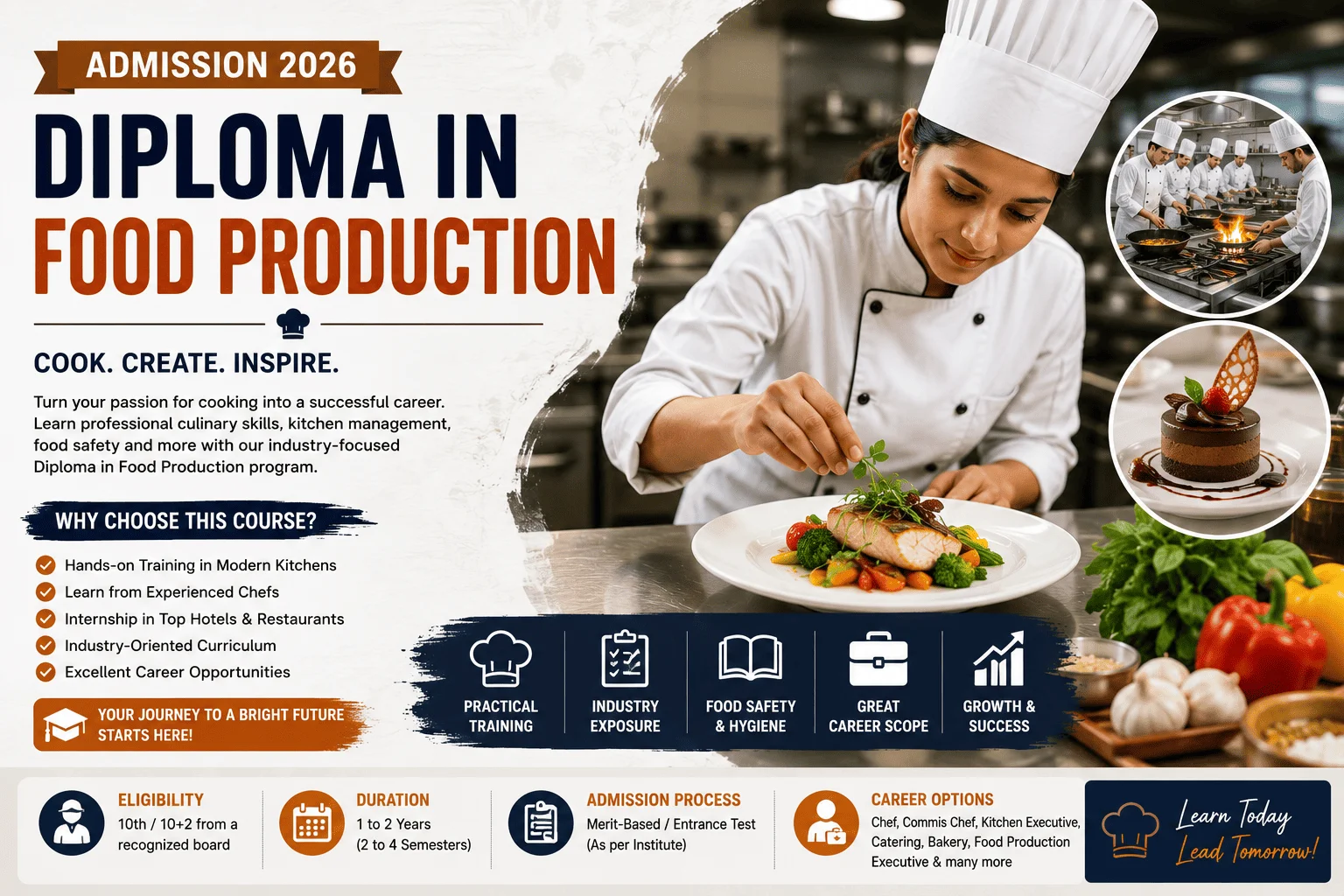
The hospitality and food service industry is one of the fastest-growing sectors worldwide, creating excellent career opportunities for skilled culinary professionals. If you have a passion for cooking, creativity, and food preparation, pursuing a Diploma in Food Production can be the perfect step toward building a successful career in the hospitality industry.
This course is designed to provide students with practical culinary skills, professional kitchen management knowledge, food safety standards, and hands-on industry experience. In this blog, you will find complete information about Diploma in Food Production Admission 2026, including eligibility, admission process, course duration, career opportunities, salary prospects, and future scope.
A Diploma in Food Production is a professional diploma program that focuses on culinary arts, food preparation, bakery and confectionery, kitchen operations, menu planning, food safety, and hospitality management. The course prepares students to work in professional kitchens by teaching modern cooking techniques, food presentation, kitchen organization, inventory management, and hygiene practices.
Students receive extensive practical training through modern kitchen laboratories, hotel internships, industrial visits, workshops, and live cooking sessions. This practical approach helps them develop confidence and become industry-ready professionals capable of working in hotels, restaurants, resorts, cruise lines, airline catering services, cafés, and food production companies.
Admissions for the Diploma in Food Production course generally begin after the declaration of the qualifying examination results. Many hotel management institutes, hospitality colleges, and universities offer admission based on academic merit, while some institutions may conduct entrance examinations, aptitude tests, or personal interviews depending on their admission policy.
Students are advised to regularly visit the official website of their preferred college to check admission notifications, application deadlines, entrance examination schedules, counseling dates, and document verification details.
Candidates interested in pursuing a Diploma in Food Production should have completed 10th or 10+2 from a recognized educational board. Eligibility requirements may vary slightly among institutions, and some colleges may specify minimum qualifying marks for admission.
Students should carefully review the eligibility guidelines of their preferred institution before submitting the application form.
Admission to the Diploma in Food Production program generally follows a simple and structured process. Candidates need to complete the application form through the college website or admission office and submit the required academic documents along with the application fee. Depending on the institution, admission may be granted through merit-based selection or an entrance examination. After shortlisting, candidates may be invited for counseling sessions, personal interviews, or document verification before the final admission is confirmed.
Students should keep the following documents ready during the admission process:
The Diploma in Food Production course is generally completed in 1 to 2 years, depending on the institution and curriculum. The program is divided into semesters and includes both theoretical learning and practical kitchen training.
During the course, students study food production techniques, Indian and international cuisine, bakery and confectionery, food science, nutrition, food safety, hygiene, kitchen operations, menu planning, hospitality communication, inventory management, cost control, and professional kitchen management. Practical laboratory sessions and internships help students gain valuable industry experience.
Practical training is one of the strongest aspects of the Diploma in Food Production program. Students work in modern training kitchens where they learn food preparation techniques, plating, bakery production, menu planning, buffet management, and commercial kitchen operations.
Most hospitality institutes also provide internships in reputed hotels, restaurants, resorts, airline catering units, and catering companies. This industry exposure helps students understand real workplace environments, improve technical skills, and develop confidence before starting their professional careers.
Throughout the course, students develop professional culinary techniques, food presentation skills, baking and confectionery knowledge, kitchen organization, menu planning, food safety awareness, hygiene practices, inventory management, teamwork, communication skills, leadership abilities, creativity, customer service, cost control, and time management. These skills are highly valued by employers in the hospitality and food service industry.
After completing the Diploma in Food Production, graduates can explore employment opportunities in hotels, luxury resorts, restaurants, cafés, cruise lines, airline catering services, industrial catering companies, hospitals, educational institutions, bakery chains, cloud kitchens, food manufacturing companies, hospitality consulting firms, and event catering organizations.
The course also provides an excellent foundation for students who wish to start their own restaurant, bakery, café, catering service, cloud kitchen, or food startup.
Graduates can begin their careers as Commis Chef, Kitchen Assistant, Cook, Food Production Associate, Bakery Assistant, Pastry Assistant, Catering Executive, Kitchen Supervisor, Demi Chef, Food Production Executive, Culinary Assistant, Restaurant Kitchen Executive, and Catering Supervisor. With experience and continuous learning, professionals can progress to positions such as Sous Chef, Executive Chef, Kitchen Manager, Corporate Chef, Food Production Manager, or Culinary Consultant.
Choosing a Diploma in Food Production provides students with excellent practical exposure, industry-recognized culinary skills, and strong employment opportunities in the hospitality sector. The course is ideal for individuals who enjoy cooking, creativity, and working in dynamic kitchen environments. With increasing demand for skilled chefs across India and internationally, graduates can build rewarding careers in hotels, restaurants, airlines, cruise companies, and luxury hospitality brands while also exploring entrepreneurship opportunities.
The salary after completing the Diploma in Food Production depends on the employer, location, experience, technical skills, and job role. Fresh graduates generally begin their careers in entry-level kitchen positions and gradually advance to supervisory and management roles. Professionals employed by luxury hotels, international hospitality groups, cruise lines, and airline catering companies often receive attractive salary packages along with accommodation, meals, incentives, and additional employment benefits.
The future scope of the Diploma in Food Production is highly promising due to the continuous expansion of the hospitality, tourism, restaurant, and food service industries. The increasing popularity of fine dining, cloud kitchens, international cuisines, luxury hospitality, and food entrepreneurship has created significant demand for qualified culinary professionals.
Graduates can pursue higher education in Hotel Management, Culinary Arts, Hospitality Management, or Bakery and Confectionery while also obtaining international chef certifications to enhance their career prospects globally.
The Diploma in Food Production is an excellent choice for students who are passionate about cooking and aspire to build successful careers in the hospitality industry. The course combines professional culinary education with practical training, internships, and industry exposure to prepare graduates for rewarding careers in hotels, restaurants, resorts, airline catering, cruise lines, and food service organizations.
With growing employment opportunities, international career prospects, and opportunities for entrepreneurship, this diploma provides a strong foundation for a successful future in the culinary and hospitality industry.
It is a professional diploma course that teaches culinary arts, food production, kitchen management, bakery, food safety, and hospitality operations.
Students who have completed 10th or 10+2 from a recognized educational board are generally eligible, subject to the admission requirements of individual institutions.
The course generally takes 1 to 2 years to complete, depending on the institute.
Yes. Most institutions provide practical kitchen training, hotel internships, workshops, bakery labs, and industrial exposure.
Graduates can work in hotels, restaurants, resorts, cafés, airline catering services, cruise lines, bakery chains, catering companies, cloud kitchens, and food manufacturing organizations.
Yes. Students can pursue B.Sc. Hotel Management, BHM, Bachelor of Culinary Arts, Advanced Diploma in Culinary Arts, or MBA in Hotel Management.


Leave A Comment
Your email address will not be published.