
Param College
Your Path to Job Oriented Courses
Approved by NCVT, MSME, UGC, QCI, MHRD | ISO 9001:2015 & 14001:2015 Certified College
Your Path to Job Oriented Courses
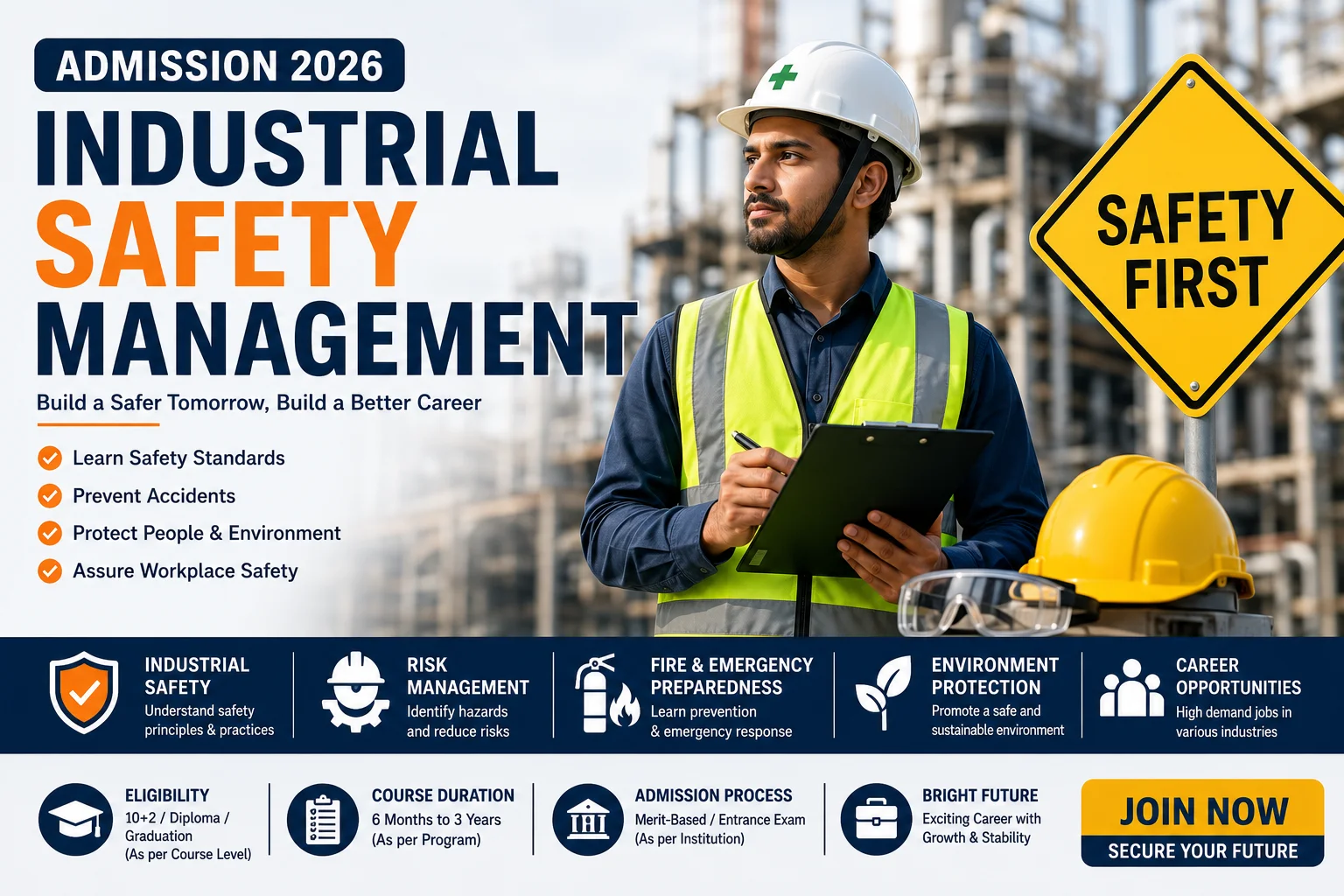
Industrial Safety Management has become one of the most important career fields in today's rapidly growing industrial sector. As industries continue to expand and workplace safety regulations become stricter, organizations are actively seeking qualified safety professionals who can protect employees, equipment, and the environment. From manufacturing plants and construction sites to oil refineries and power plants, industrial safety experts play a vital role in preventing accidents and ensuring smooth business operations.
If you are planning to pursue an Industrial Safety Management course, understanding the admission process, eligibility criteria, course structure, career opportunities, and future scope is essential. This guide provides complete information about Industrial Safety Management Admission 2026 to help students choose the right course and institution.
Industrial Safety Management is a professional course that focuses on workplace safety, occupational health, industrial risk management, environmental protection, emergency planning, and accident prevention. The course trains students to identify workplace hazards, implement safety procedures, conduct safety inspections, perform risk assessments, and ensure compliance with industrial safety regulations.
Students also gain practical knowledge of fire prevention systems, disaster management, industrial hygiene, safety auditing, hazardous material handling, and occupational health standards. The program combines classroom learning with practical training, industrial visits, workshops, internships, and live safety projects to prepare students for real industrial environments.
Admission to the Industrial Safety Management course generally begins after the announcement of qualifying examination results. Many institutes offer admission based on academic merit, while some universities and colleges may conduct entrance examinations or personal interviews depending on their admission policies.
Candidates should regularly visit the official website of their preferred institution to stay updated on application dates, admission schedules, counseling sessions, and document verification procedures.
Eligibility for Industrial Safety Management varies according to the course level offered by the institution. Certificate courses generally require candidates to have completed the 10th standard, diploma programs usually require 10+2, while undergraduate and postgraduate programs have their own educational requirements. Some institutions may also specify minimum qualifying marks or conduct entrance examinations.
Applicants should carefully review the eligibility requirements of the college or university before applying for admission.
The admission process generally begins with online or offline registration through the institution's official website or admission office. Candidates must complete the application form, upload or submit the required documents, and pay the application fee before the deadline. Depending on the institution, admission may be based on merit or entrance examination performance. After shortlisting, candidates may be invited for counseling, document verification, or personal interviews before final admission is confirmed.
Students should keep the following documents ready during the admission process:
The duration of the Industrial Safety Management course depends on the program selected. Certificate courses generally range from 6 months to 1 year, diploma programs usually require 1 to 2 years, while undergraduate degree programs are generally completed in 3 years. During the course, students study industrial safety, fire prevention, occupational health, environmental safety, disaster management, safety legislation, hazard identification, accident investigation, emergency response planning, and industrial risk management.
Most institutions also provide practical training, industrial visits, internships, workshops, fire drills, and project work to help students gain hands-on experience.
After completing Industrial Safety Management, graduates can pursue careers in manufacturing industries, construction companies, oil and gas organizations, petrochemical industries, power plants, mining companies, aviation, railways, shipping, healthcare organizations, infrastructure companies, government safety departments, environmental agencies, and private safety consulting firms.
The increasing emphasis on workplace safety and legal compliance has created excellent employment opportunities for qualified safety professionals across India and internationally.
Industrial Safety Management is an excellent career choice for students who want to work in industrial operations, workplace safety, occupational health, and environmental management. The course offers practical learning, strong industry demand, stable career growth, and opportunities to work in diverse sectors. It also provides the technical and managerial skills required to maintain safe working environments and reduce industrial risks.
Professionals in this field contribute significantly to protecting human life, company assets, and the environment while ensuring compliance with national and international safety standards.
The future scope of Industrial Safety Management is highly promising due to continuous industrial growth, stricter workplace safety regulations, and increasing awareness of occupational health and environmental protection. Every major industry requires trained safety professionals to maintain compliance and reduce workplace accidents.
Graduates can pursue careers in India and abroad, obtain international HSE certifications, establish independent safety consulting firms, or continue higher education in Safety Engineering, Fire & Industrial Safety, Occupational Health, Environmental Management, or Disaster Management.
Industrial Safety Management is a rewarding career option for students interested in workplace safety, industrial operations, and emergency management. The course provides a combination of technical knowledge, practical training, and professional skills that prepare graduates for responsible roles across various industries. With increasing demand for qualified safety professionals worldwide, Industrial Safety Management offers excellent career growth, job stability, and opportunities to contribute to safer workplaces and sustainable industrial development.
Industrial Safety Management is a professional course that focuses on workplace safety, industrial risk management, occupational health, fire prevention, environmental protection, and emergency response.
Eligibility depends on the course level. Certificate programs generally require 10th pass, diploma programs require 10+2, while undergraduate and postgraduate programs have their own academic requirements.
Admission may be based on academic merit or entrance examinations, depending on the institution.
The course duration varies from 6 months to 3 years, depending on the program selected.
Graduates can work in manufacturing, construction, oil and gas, mining, aviation, shipping, railways, healthcare, infrastructure, government departments, and private safety consulting organizations.
Yes. Students may pursue B.Sc. Fire & Industrial Safety, M.Sc. Industrial Safety, MBA in Safety Management, M.Tech. Safety Engineering, postgraduate diploma programs, or doctoral research.



Leave A Comment
Your email address will not be published.