
Param College
Your Path to Job Oriented Courses
Approved by NCVT, MSME, UGC, QCI, MHRD | ISO 9001:2015 & 14001:2015 Certified College
Your Path to Job Oriented Courses
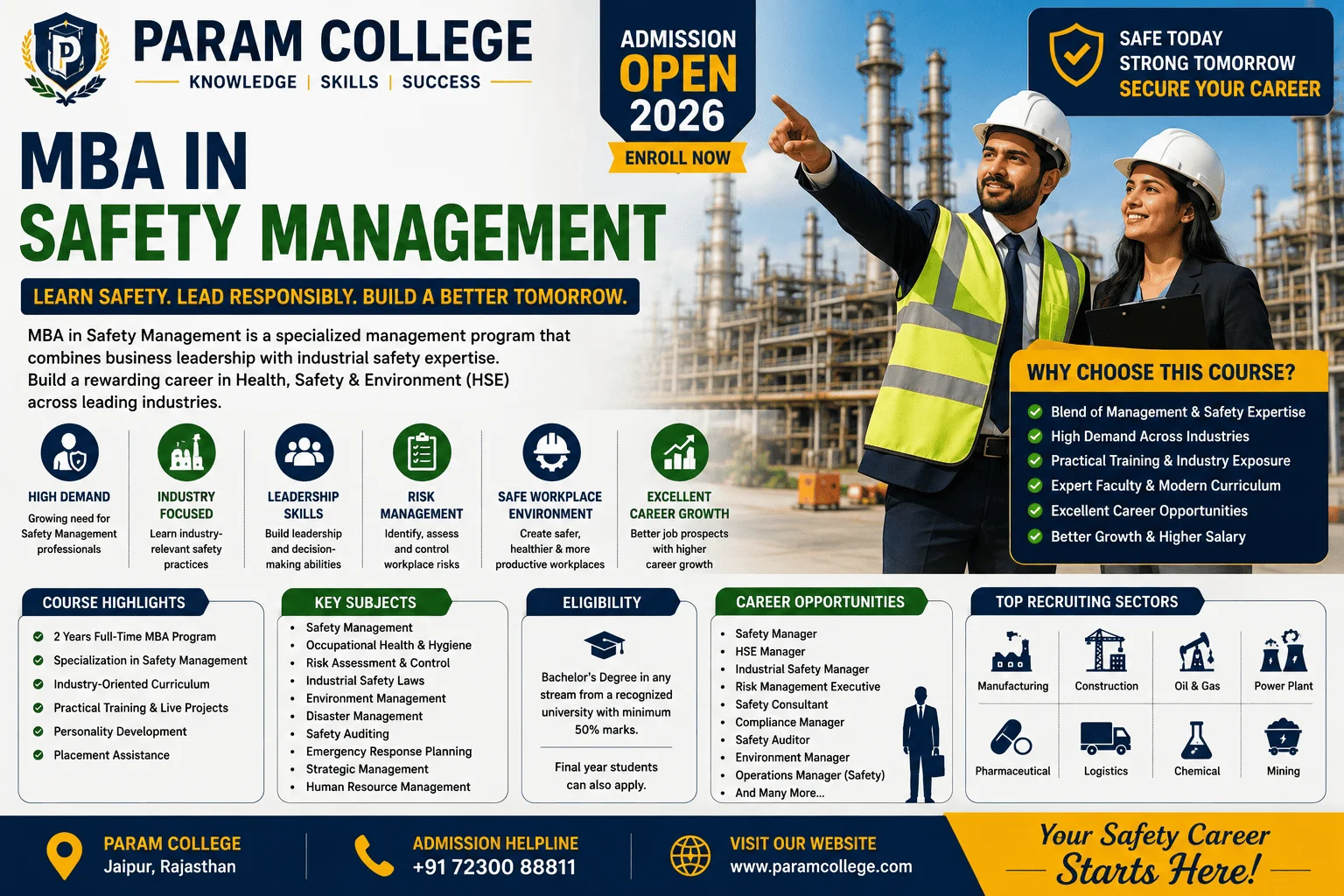
Safety has become one of the most important priorities for modern industries. Manufacturing plants, construction companies, oil and gas industries, power plants, chemical industries, hospitals, logistics companies, infrastructure projects, and multinational organizations require qualified professionals who can identify risks and create effective safety systems. With the growing importance of workplace safety and regulatory compliance, professionals with management knowledge and specialized safety skills are gaining significant career opportunities.
An MBA in Safety Management is designed for students and working professionals who want to develop advanced knowledge of business management along with occupational health, industrial safety, risk management, emergency planning, and workplace safety. For students looking for a career-oriented management program in Rajasthan, MBA in Safety Management in Jaipur can be an excellent option.
Jaipur has become an important education destination in Rajasthan, with universities and institutions offering a wide range of management and professional programs. Students can explore suitable institutions and admission options according to their academic qualifications, career goals, budget, and specialization requirements.
MBA in Safety Management is a postgraduate management program that combines traditional business administration with specialized knowledge of occupational health and safety. The course focuses on developing professionals who can manage safety operations, identify workplace hazards, conduct risk assessments, develop emergency response plans, and implement safety policies within an organization.
Unlike a general MBA, this specialization gives students an opportunity to understand the management side of industrial safety. Along with subjects related to management, students may study areas such as industrial safety, occupational health, environmental management, disaster management, risk assessment, safety auditing, emergency preparedness, and regulatory compliance.
The program is particularly suitable for individuals who want to move into managerial and leadership positions within the Health, Safety and Environment (HSE) sector.
Industries today are increasingly focused on preventing accidents, protecting employees, reducing operational risks, and complying with safety regulations. A safety professional is no longer responsible only for checking equipment or conducting inspections. Modern safety managers are involved in planning, policy development, risk analysis, employee training, emergency preparedness, compliance, and organizational decision-making.
An MBA in Safety Management helps students understand these responsibilities from a management perspective. The combination of management skills and safety expertise can help professionals take on greater responsibilities and progress toward senior positions.
The course can be particularly beneficial for students who want to build careers in manufacturing, construction, oil and gas, pharmaceuticals, power generation, infrastructure, logistics, mining, and other high-risk industries.
Jaipur is one of the leading education hubs in Rajasthan and provides students with access to universities and professional institutions offering management and specialized courses. Students interested in safety management can explore MBA programs with safety, occupational health, industrial safety, HSE, or related specializations, depending on the institution and current program availability.
Studying in Jaipur can also provide students with access to a growing industrial and commercial environment. The surrounding Rajasthan region has manufacturing units, construction projects, mining activities, hospitality businesses, infrastructure companies, and other organizations where safety management plays an important role.
Before taking admission, students should always verify the current course structure, university recognition, eligibility, specialization availability, fee structure, and admission requirements of the selected institution.
| Particular | Details |
|---|---|
| Course Name | MBA in Safety Management |
| Course Level | Postgraduate |
| Duration | Generally 2 Years |
| Eligibility | Graduation from a Recognized University |
| Admission | Merit / Entrance-Based as per Institution |
| Learning Mode | Regular / Other Modes as Offered |
| Major Areas | Safety, Risk, HSE & Management |
| Career Sector | Government & Private Industries |
| Location Focus | Jaipur, Rajasthan |
Candidates who wish to pursue an MBA in Safety Management generally need to complete a bachelor's degree from a recognized university. The minimum percentage requirement and accepted graduation streams may vary depending on the university or institution offering the program.
Students from engineering, science, commerce, management, and other relevant academic backgrounds may find this specialization useful, particularly if they are interested in industrial safety and organizational management. Some institutions may also have additional admission requirements such as entrance examinations, interviews, or other selection criteria.
Candidates should check the latest eligibility requirements of the specific university before applying.
The admission process for an MBA in Safety Management generally starts with selecting a suitable university or institution. Students should compare the program curriculum, university recognition, faculty, infrastructure, practical exposure, placement opportunities, and total fee before making their decision.
After confirming eligibility, candidates can complete the application form and submit the required academic and identity documents. Depending on the institution, admission may be offered on the basis of merit, an entrance examination, interview, or a combination of these methods.
Once selected, students complete document verification and fee payment to confirm their enrollment in the program.
The curriculum combines management concepts with specialized safety and risk-management subjects. Students gain an understanding of how safety policies are developed, implemented, monitored, and improved within an organization.
Common areas of study may include Principles of Management, Organizational Behaviour, Human Resource Management, Financial Management, Marketing Management, Operations Management, Industrial Safety Management, Occupational Health and Safety, Risk Assessment and Management, Environmental Management, Disaster Management, Fire Safety Management, Safety Auditing, Emergency Planning, Industrial Legislation, Environmental Health, Quality Management, and Health, Safety & Environment Management.
The exact syllabus can vary according to the university and program structure.
Safety management is a field where practical knowledge is extremely important. Classroom education alone is not enough to understand the risks present in an actual industrial environment. Therefore, students may receive practical exposure through industrial visits, safety audits, case studies, workshops, seminars, emergency drills, projects, and internships.
Such activities help students understand workplace hazards and learn how safety policies are applied in real organizations. Practical exposure also helps develop communication, leadership, problem-solving, decision-making, and crisis-management skills.
An MBA in Safety Management helps students develop both managerial and technical competencies. They learn how to identify hazards, assess risks, prepare safety plans, conduct audits, investigate accidents, and improve workplace safety systems.
At the management level, students develop leadership, team management, communication, project management, strategic planning, decision-making, and organizational skills. These combined capabilities can help professionals manage safety teams and coordinate safety operations across large organizations.
After completing an MBA in Safety Management, graduates can explore career opportunities in organizations where workplace safety, environmental compliance, risk control, and occupational health are important. Professionals may work with manufacturing companies, construction firms, oil and gas organizations, chemical industries, power plants, pharmaceutical companies, mining companies, hospitals, logistics organizations, infrastructure companies, and multinational corporations.
Depending on experience and qualifications, graduates can work in positions such as Safety Manager, HSE Manager, Safety Officer, Industrial Safety Manager, Risk Management Executive, HSE Coordinator, Safety Consultant, Safety Auditor, Environmental Health and Safety Manager, Disaster Management Professional, and Compliance Manager.
| Job Profile | Major Responsibility |
| Safety Manager | Managing workplace safety systems |
| HSE Manager | Managing Health, Safety & Environment programs |
| Industrial Safety Manager | Controlling industrial hazards and risks |
| Safety Consultant | Advising organizations on safety practices |
| Risk Management Executive | Identifying and controlling organizational risks |
| Safety Auditor | Reviewing safety systems and compliance |
| HSE Coordinator | Coordinating safety and environmental activities |
| Compliance Manager | Monitoring regulatory and safety requirements |
The scope of Safety Management is spread across multiple industries. Manufacturing and construction companies require safety managers to control workplace hazards, while oil and gas and chemical industries need professionals who understand high-risk operations.
Power plants, mining companies, pharmaceutical organizations, hospitals, airports, logistics companies, infrastructure projects, hotels, and large corporate organizations also require trained safety and HSE professionals.
This wide industry application makes Safety Management a versatile career field for management graduates.
The salary of a Safety Management professional depends on educational qualifications, previous experience, industry, job responsibilities, location, and additional certifications. Fresh graduates may begin with entry-level safety or HSE positions, while experienced professionals can progress into managerial and senior leadership roles.
| Experience Level | Indicative Salary Range |
| Fresher | ₹3 – ₹6 LPA |
| 2–5 Years | ₹5 – ₹10 LPA |
| 5–10 Years | ₹8 – ₹15 LPA |
| Senior Management | ₹15 LPA+ |
These figures are indicative and can vary considerably depending on the employer, location, qualifications, and professional experience.
After completing an MBA in Safety Management, professionals can continue developing their expertise through specialized certifications and advanced programs in occupational health and safety, fire safety, environmental management, risk management, disaster management, and HSE.
Additional professional qualifications can strengthen a candidate's profile, particularly when applying for specialized safety and management positions in large organizations.
Safety professionals can explore opportunities in both government and private organizations, subject to the eligibility requirements of individual recruitment notifications.
Government-related opportunities may exist in departments, public sector organizations, industrial establishments, infrastructure projects, and other bodies where safety professionals are required. In the private sector, opportunities are available across manufacturing, construction, oil and gas, pharmaceuticals, power, logistics, mining, and other industries.
Candidates should always check the specific educational and professional requirements mentioned in official recruitment notifications.
Choosing the right university and specialization is an important decision. Admission Sahayata helps students understand different MBA options and select programs according to their academic background, career goals, budget, and preferred location.
Our admission guidance can help students understand eligibility requirements, compare institutions, prepare documents, complete application procedures, and receive support throughout the admission process. Students looking for MBA in Safety Management Admission in Jaipur can connect with Admission Sahayata for personalized guidance.
An MBA in Safety Management can be a strong career choice for students and professionals who want to combine management expertise with specialized knowledge of workplace safety, occupational health, risk management, and environmental protection. As organizations continue to focus on employee safety, regulatory compliance, accident prevention, and sustainable operations, the need for skilled safety and HSE professionals continues to grow.
For students planning to study in Rajasthan, MBA in Safety Management in Jaipur offers an opportunity to pursue a specialized management career in an education-friendly city. Before applying, candidates should carefully compare universities, verify recognition and program availability, understand the complete fee structure, and review the admission requirements.
With the right education, practical exposure, and professional skills, an MBA in Safety Management can help students move toward responsible and rewarding careers in the safety and industrial management sector.
MBA in Safety Management is a postgraduate management program that combines business administration with occupational safety, industrial risk management, HSE, emergency planning, and workplace safety.
Graduates who have completed a bachelor's degree from a recognized university can generally apply, subject to the eligibility criteria of the institution offering the program.
Management institutions and universities in Jaipur may offer safety, HSE, occupational health, or related management programs. Students should verify the current availability and exact specialization before applying.
Graduates can work as Safety Managers, HSE Managers, Industrial Safety Managers, Safety Consultants, Risk Management Executives, Safety Auditors, Compliance Managers, and other related professionals.
Yes. The specialization can provide opportunities across manufacturing, construction, oil and gas, power, pharmaceuticals, mining, infrastructure, logistics, and other industries where safety management is essential.
Salary varies according to experience, industry, location, and employer. Freshers may start around ₹3–₹6 LPA, while experienced professionals can earn significantly more in managerial and senior positions.



Leave A Comment
Your email address will not be published.