
Param College
Your Path to Job Oriented Courses
Approved by NCVT, MSME, UGC, QCI, MHRD | ISO 9001:2015 & 14001:2015 Certified College
Your Path to Job Oriented Courses
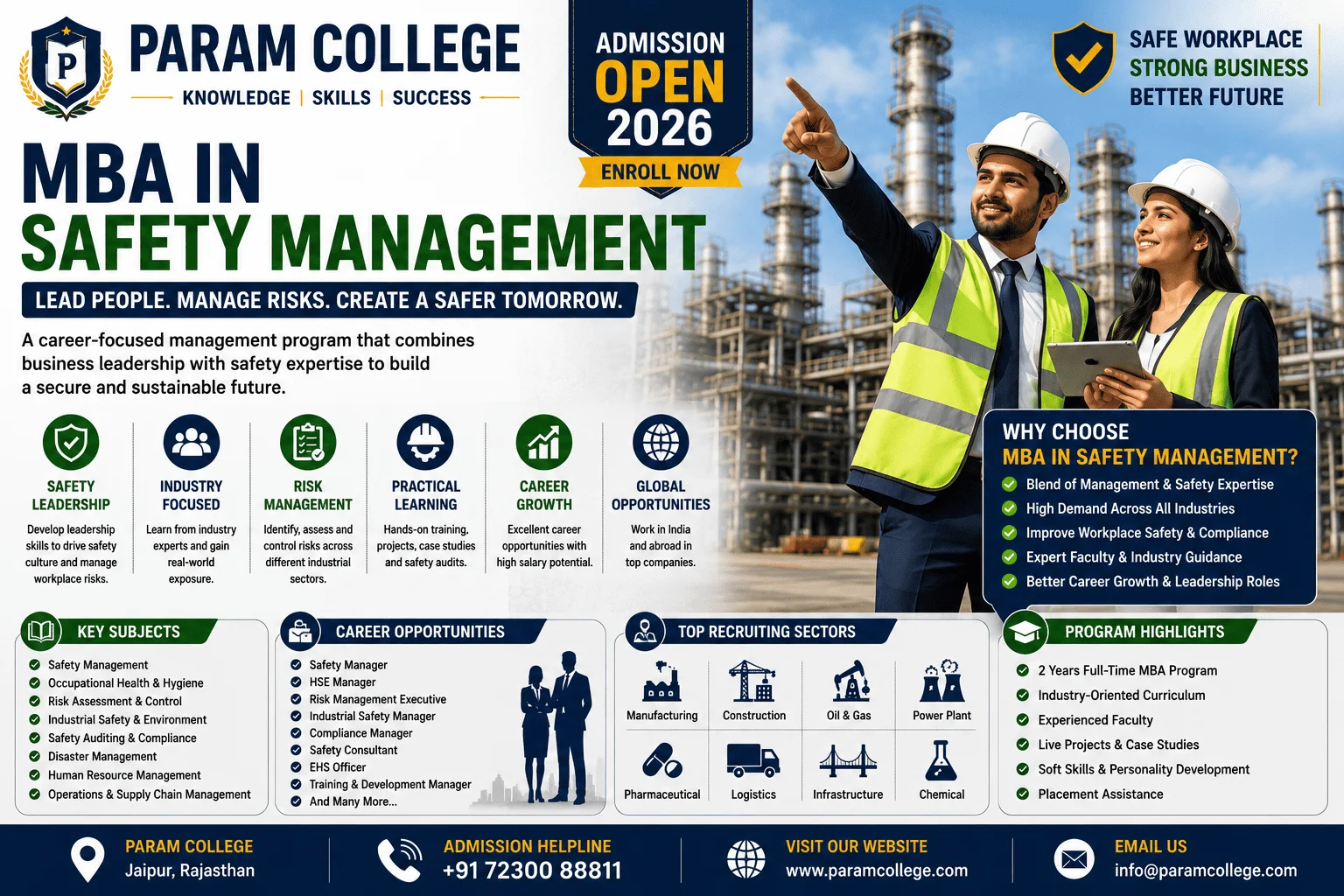
Workplace safety has become a major priority for organizations across almost every industry. From manufacturing plants and construction sites to hospitals, power plants, chemical industries, logistics companies, oil and gas facilities, and large infrastructure projects, organizations need professionals who can manage safety operations while also understanding business and organizational requirements.
This changing industrial environment has created a growing need for professionals who can combine management knowledge with safety expertise. An MBA in Safety Management is designed for students and professionals who want to understand how organizations can effectively manage workplace risks, protect employees, improve safety standards, and maintain efficient operations.
Param College focuses on career-oriented education and practical understanding, helping students develop the knowledge and professional skills required to work in the modern safety and management sector. The program can provide a strong foundation for students who want to build careers in Safety Management, HSE, Risk Management, Industrial Safety, Compliance, and related fields.
A traditional MBA develops knowledge of business administration, finance, marketing, human resources, operations, and organizational management. An MBA in Safety Management adds another important dimension by focusing on workplace safety, occupational health, risk control, emergency preparedness, environmental concerns, and safety leadership.
This combination allows students to understand safety not only as a technical responsibility but also as an important part of business management. A safety manager must be able to communicate with employees, coordinate teams, prepare safety policies, evaluate risks, manage resources, conduct safety audits, and support organizational decision-making.
The program is therefore suitable for students who want to take managerial responsibility in organizations where safety and risk management are essential.
Industrial development brings new technologies, larger workforces, complex machinery, and demanding operational environments. Along with these developments, organizations face different types of workplace risks. Effective safety management helps businesses identify these risks and take preventive measures before accidents occur.
A well-managed safety system can help organizations protect employees, reduce workplace incidents, improve productivity, maintain regulatory compliance, and protect valuable equipment and infrastructure. Because of these responsibilities, safety professionals are increasingly becoming an important part of organizational management teams.
An MBA in Safety Management prepares students to understand these challenges from both technical and managerial perspectives.
Param College aims to provide students with career-focused education that connects academic concepts with practical industry requirements. Safety Management is a field where students need more than textbook knowledge, because professional safety responsibilities often involve real-world decision-making and risk evaluation.
The learning approach at Param College emphasizes understanding safety systems, management principles, risk assessment, workplace hazards, emergency planning, and organizational safety practices. Through practical activities, projects, case-based learning, workshops, and industry-oriented exposure wherever applicable, students can develop a better understanding of how safety management works in professional environments.
The college also focuses on developing communication, leadership, teamwork, and decision-making abilities so that students can confidently handle managerial responsibilities in the future.
| Particular | Details |
|---|---|
| Course Name | MBA in Safety Management |
| College | Param College |
| Course Level | Postgraduate |
| Duration | Generally 2 Years |
| Eligibility | Bachelor's Degree as per University Norms |
| Learning Approach | Theory + Practical + Projects |
| Major Areas | Safety, Risk, HSE & Management |
| Career Areas | Safety, HSE, Risk Management & Compliance |
| Admission | As per College/University Guidelines |
The exact duration, eligibility, syllabus, specialization, and admission requirements should be confirmed according to the current program and applicable university regulations.
MBA in Safety Management is suitable for students who are interested in management as well as workplace safety and risk prevention. It can also be useful for graduates who already have a technical or science background and want to develop managerial capabilities.
Students who enjoy problem-solving, leadership, planning, teamwork, emergency management, and working in industrial environments may find this specialization particularly suitable. Professionals already working in safety-related positions can also consider advanced management education to strengthen their career profile, subject to the applicable eligibility requirements.
Candidates generally need to hold a bachelor's degree from a recognized university to apply for an MBA program. The minimum marks, accepted academic backgrounds, entrance requirements, and other conditions can vary between institutions.
Students should carefully check the eligibility requirements of the specific MBA in Safety Management program before applying. Admission may also depend on merit, entrance examination scores, interviews, or other selection procedures prescribed by the university or institution.
The admission journey generally begins with selecting the right MBA in Safety Management program and reviewing its eligibility criteria, curriculum, fees, learning facilities, and career opportunities.
After confirming eligibility, students can complete the application form and submit the required documents. Depending on the applicable admission rules, candidates may be selected through merit, an entrance examination, interview, or another prescribed process.
After selection, students complete document verification and fee formalities to confirm their admission.
Param College provides guidance to students during the admission process so that they can understand the requirements and complete the necessary formalities properly.
The course combines management education with specialized safety-related knowledge. Students develop an understanding of how organizations plan, implement, monitor, and improve their workplace safety systems.
The curriculum may include subjects and areas such as Safety Management, Occupational Health, Industrial Safety, Risk Assessment, Environmental Management, Disaster Management, Emergency Planning, Safety Auditing, Industrial Safety Laws, Human Resource Management, Operations Management, Organizational Behaviour, Strategic Management, Quality Management, and Project Management.
The exact subjects may vary according to the university and the approved curriculum.
Safety Management requires professionals to make decisions based on real workplace conditions. For this reason, practical learning plays an important role in developing professional confidence.
At Param College, students can develop practical understanding through projects, case studies, demonstrations, workshops, industrial exposure, and safety-related activities wherever applicable. These experiences help students understand how hazards are identified, how risks are assessed, and how preventive measures can be implemented within an organization.
Such learning also helps students understand the importance of communication between safety departments, employees, management teams, and other operational departments.
An MBA in Safety Management can help students develop a combination of managerial and safety-related skills. Students learn how to evaluate workplace risks, understand safety policies, participate in safety audits, prepare emergency plans, and contribute to accident-prevention strategies.
At the same time, the management component helps students strengthen leadership, communication, team coordination, strategic planning, project management, decision-making, negotiation, and problem-solving skills.
These combined skills can be valuable when progressing from entry-level responsibilities to managerial positions.
The career scope of Safety Management extends across several industries because organizations of different sizes require systems to manage workplace health, safety, environmental risks, and regulatory requirements.
After completing the program, graduates can explore positions such as Safety Manager, HSE Manager, Industrial Safety Manager, Safety Consultant, Risk Management Executive, HSE Coordinator, Safety Auditor, Compliance Manager, Environment Health & Safety Professional, Safety Training Executive, and Operations Manager with safety responsibilities.
With experience and additional professional qualifications, individuals can progress toward senior safety and management positions.
Safety professionals are required in industries where employees work with machinery, chemicals, construction activities, industrial processes, heavy equipment, or other operational risks.
| Sector | Possible Safety Responsibilities |
| Manufacturing | Workplace & Industrial Safety |
| Construction | Site Safety & Risk Management |
| Oil & Gas | Process Safety & Emergency Planning |
| Power | Industrial Fire & Safety Management |
| Chemical | Hazard Identification & Risk Control |
| Pharmaceuticals | Occupational Health & Compliance |
| Mining | Industrial Risk Management |
| Infrastructure | Project & Site Safety |
| Logistics | Workplace & Operational Safety |
| Hospitals | Occupational Health & Emergency Safety |
Safety Management offers opportunities for professionals who continuously develop their technical knowledge and leadership capabilities. A graduate may begin with a safety or HSE-related role and gradually take responsibility for larger teams, projects, plants, or organizational safety systems.
Experience in high-risk industries can provide exposure to complex safety challenges and help professionals develop specialized expertise. Additional certifications, practical experience, and advanced education can further strengthen career opportunities.
Professionals with strong leadership and management skills may eventually move into senior HSE management, corporate safety, risk management, compliance, consulting, or strategic safety roles.
Salary varies according to qualification, experience, industry, job role, location, and employer. Fresh graduates may begin with entry-level safety or HSE positions, while experienced professionals can move into managerial and specialist roles.
| Experience | Indicative Salary Range |
| Fresher | ₹3 – ₹6 LPA |
| 2–5 Years | ₹5 – ₹10 LPA |
| 5–10 Years | ₹8 – ₹15 LPA |
| Senior-Level Professionals | ₹15 LPA+ |
These figures are indicative and actual salaries can differ significantly depending on the organization, responsibilities, experience, and professional qualifications.
An MBA can be the foundation for continued professional development in areas such as Occupational Health and Safety, Industrial Safety, Environmental Management, Risk Management, Fire Safety, Disaster Management, and HSE.
Professionals may also pursue specialized certifications and advanced training according to their career objectives. Continuous learning is particularly valuable in safety management because industrial technologies, regulations, and safety practices continue to evolve.
A career in Safety Management provides professionals with an opportunity to contribute directly to the protection of employees, infrastructure, and business operations. The role combines technical understanding, management responsibilities, leadership, and problem-solving.
For students who want a career where their work has a direct impact on creating safer workplaces, this field can be both professionally meaningful and financially rewarding. The wide range of industries requiring safety professionals also provides flexibility when choosing a career path.
Param College focuses on creating a learning environment where students can develop academic knowledge as well as practical and professional skills. For MBA in Safety Management students, the emphasis on safety concepts, management principles, practical understanding, projects, and career development can help build a strong foundation for professional growth.
The college aims to prepare students to understand real-world organizational challenges and develop the confidence required to work in professional safety and management environments.
For students looking to combine management education with safety specialization, Param College can be considered as an option for pursuing a career-oriented MBA program.
An MBA in Safety Management can be an excellent choice for students and professionals who want to combine business management with occupational health, industrial safety, risk management, and HSE practices. As organizations continue to focus on employee protection, regulatory compliance, operational continuity, and risk reduction, the role of skilled safety management professionals is becoming increasingly important.
Param College provides a career-focused learning environment where students can develop management knowledge along with practical understanding of safety and risk management. Through academic learning, projects, practical activities, and professional development, students can prepare themselves for a wide range of career opportunities across industries.
If you are looking for a specialized management career where leadership, responsibility, safety, and organizational management come together, MBA in Safety Management can be a strong career choice.
MBA in Safety Management is a postgraduate management program that combines business administration with workplace safety, occupational health, risk management, HSE, and safety leadership.
Graduates with a bachelor's degree from a recognized university can generally apply, subject to the eligibility requirements of the institution offering the program.
Graduates can explore roles such as Safety Manager, HSE Manager, Industrial Safety Manager, Safety Consultant, Risk Management Executive, Safety Auditor, Compliance Manager, and HSE Coordinator.
Manufacturing, construction, oil and gas, chemicals, power, mining, pharmaceuticals, infrastructure, logistics, healthcare, and other industries hire professionals for safety and HSE-related responsibilities.
Yes. It can be a strong option for students interested in management, workplace safety, risk control, leadership, and industrial operations, particularly as organizations continue to prioritize employee safety and regulatory compliance.
Param College focuses on career-oriented education, practical understanding, management skills, technical learning, projects, and professional development to help students prepare for careers in safety and management.



Leave A Comment
Your email address will not be published.